

Some performances impress.
And then some performances carryhistory.
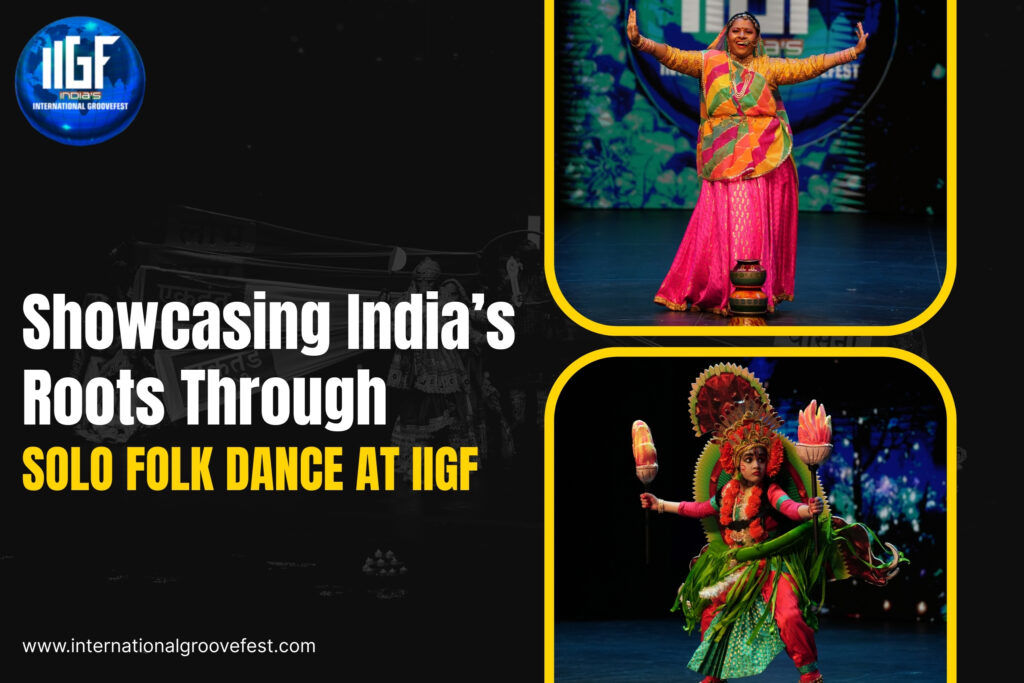
When a dancer steps onto the stage alone, carrying the rhythm of a village, the stories of ancestors, and the spirit of a region, something extraordinary happens. The stage stops being just a platform. It becomes a living archive of culture.
That is the power of Solo Folk Dance.
At India’s International Groovefest (IIGF), solo folk dance is not treated as just another category. It is honoured as a voice of heritage, a celebration of identity, and a bridge between generations. In a world where trends change fast and styles evolve every season, solo folk dance stands as a reminder of where movement truly comes from community, ritual, and lived tradition.
And at the 2026 folk dance competition, this tradition takes centre stage like never before.
Why Solo Folk Dance Matters More Than Ever
Folk dance is not created in studios.
It is born in courtyards, fields, festivals, temples, and celebrations.
Every step carries a story. Every rhythm carries memory.
When a performer presents solo Indian folk dance, they are not just showing technique, they are representing:
- A region’s culture
- A community’s way of life
- Generations of tradition passed through the movement
- Stories of harvest, devotion, celebration, and struggle
In group folk performances, the energy of the community shines. But in solo folk dance, something even more intimate happens. The dancer becomes the single storyteller. The entire tradition flows through one body, one expression, one presence on stage.
That is why the solo folk dance competition at IIGF holds such special meaning. It gives individual artists the chance to carry their culture on a global stage-alone, proud, and powerful.
From Village Roots to National and Global Stages
What once lived in village celebrations and regional festivals now finds space on some of the world’s most respected platforms. IIGF has become a place where folk traditions are not only preserved, but presented with dignity, scale, and visibility.
For many artists, participating in a folk dance competition is more than a performance opportunity. It is:
- A chance to represent their roots
- A way to keep traditions alive
- A platform to show that folk is not “old”- it is timeless
At IIGF, solo folk dancers don’t compete only for scores. They perform for recognition, respect, and representation. This is why the competition is often spoken of in the same breath as a national folk dance competition, not because it limits itself to one country, but because it carries the spirit of national heritage onto an international stage.
Here, folk is not a side category.
It is a cultural statement.
What Makes IIGF’s Solo Folk Dance Platform Special
IIGF was never designed to celebrate only one style of dance. It was created to honour movement in all its cultural forms. And within that vision, solo folk dance holds a deeply respected place.
At IIGF:
- Folk traditions are treated as heritage, not trends
- Performers are seen as cultural carriers, not just competitors
- Each region’s style is respected for its authenticity and roots
- Storytelling matters as much as technique
- Expression matters as much as execution
This approach is what transforms a regular folk dance competition into a meaningful cultural experience. It also gives solo performers the confidence that they are not being judged only on spectacle but on truth, tradition, and artistic integrity.
Solo Folk Dance: One Dancer, One Culture, One Story
Performing solo is not easy.
There is no group to hide behind.
No formation to rely on.
No shared energy to lean into.
In solo folk dance, the dancer becomes the entire narrative.
- The footwork must speak
- The expressions must explain
- The rhythm must carry emotion
- The costume must represent history
- The movement must hold meaning
This is what makes the solo folk dance competition so powerful to watch and so meaningful to perform in.
A solo folk dancer does not just perform steps. They translate culture into movement.
From Regional Identity to Global Recognition
One of the most beautiful things about IIGF is that it brings together dancers from many countries, cultures, and traditions. Every year, artists arrive with diverse folk roots, musical languages, and movement styles.
On this stage:
- Indian folk traditions meet global folk cultures
- Regional stories meet international audiences
- Local heritage meets worldwide appreciation
For a performer presenting solo Indian folk dance, this becomes a rare opportunity: to show the world not just how you dance, but where you come from.
This is how IIGF transforms a performance into a cultural exchange. And this is why folk dance competition 2026 is not just another event – it is a meeting point of traditions.
More Than a Competition: A Career and Cultural Turning Point
For many dancers, stepping onto the IIGF stage becomes a defining moment.
Because here, folk artists receive:
- International exposure
- Recognition beyond their region
- Opportunities to perform on global platforms
- Visibility among cultural institutions and media
- A chance to turn passion into a profession
And yes, there are also meaningful rewards, including ₹5 Lakhs in cash prizes, along with recognitions and professional opportunities in the dance and entertainment world.
But more than that, dancers gain something deeper: credibility, confidence, and global connection.
This is where a folk performer stops being “local” and starts being global, without losing their roots.
Who Should Participate in the Solo Folk Dance Category?
If you are:
- A solo folk dancer rooted in tradition
- A performer carrying regional or cultural heritage
- An artist who believes folk is more than entertainment
- Someone who wants to represent culture, not trends
- A dancer ready to step onto a bigger stage
Then this platform is for you.
Whether you come from a village, a city, a cultural academy, or a family tradition – your story belongs here.
Judging with Respect for Culture
At IIGF, folk is not judged like a commercial performance.
Judges look for:
- Authenticity
- Cultural understanding
- Musical connection
- Expression and storytelling
- Technique rooted in tradition
- Stage presence with purpose
It’s not about copying steps.
It’s about carrying culture.
Not about speed.
But about the soul.
This approach ensures that the solo folk dance competition remains true to its purpose: honouring heritage, not just entertaining audiences.
Why Solo Folk Dance at IIGF Feels Different
At IIGF, solo folk dance is not treated as just another performance category. It is treated as heritage in motion.
Because here, your tradition is respected, not simplified, not commercialized, and not reduced to a spectacle. Every form is welcomed with the understanding that it comes from a living culture, shaped by history, rituals, festivals, and community life. Your roots are celebrated, whether they come from a small village, a regional tradition, or a family lineage passed down through generations.
Here, your story is heard not just through steps, but through expression, music, costume, and presence. The stage becomes a space where your personal journey and your cultural journey meet. Audiences don’t just watch you dance; they experience where you come from, what you carry, and what your movement represents.
Here, your culture is seen not as a background element, but as the heart of the performance. The spotlight is not only on technique, but on meaning. On the rhythm that reflects seasons and celebrations. On gestures that hold memory. On movements that carry identity.
And here, your journey is valued not only the final performance, but the years of learning, practice, discipline, and devotion that brought you to the stage. IIGF recognizes that every folk dancer carries more than choreography; they carry responsibility, tradition, and pride.
That is why IIGF doesn’t just host a folk dance competition. It creates a living space where folk lives, breathes, and grows without losing its essence. A space where tradition is not frozen in the past, but carried forward with dignity. Where culture is not diluted, but shared with the world. And where every solo folk dancer is not just a performer, but a cultural voice on a global stage.
Looking Ahead to Folk Dance Competition 2026
As folk dance competition 2026 approaches, one thing is clear: the world is ready to see culture in motion.
This is not just another stage.
It is a place where:
- Villages meet the world
- Traditions meet the future
- And dancers become cultural ambassadors
For every artist performing solo Indian folk dance, this is more than participation.
It is representation.
Where One Dance Becomes a Legacy
Some dances entertain.
Some dances preserve memory.
And some dances carry entire cultures forward.
At IIGF, solo folk dance is not just performed.
It is honoured.
Because when one dancer steps onto that stage with their tradition, their rhythm, and their story –
They don’t just perform.
They carry history.
They become heritage.
They make culture visible to the world.
And that is what makes Solo Folk Dance at IIGF truly unforgettable.