




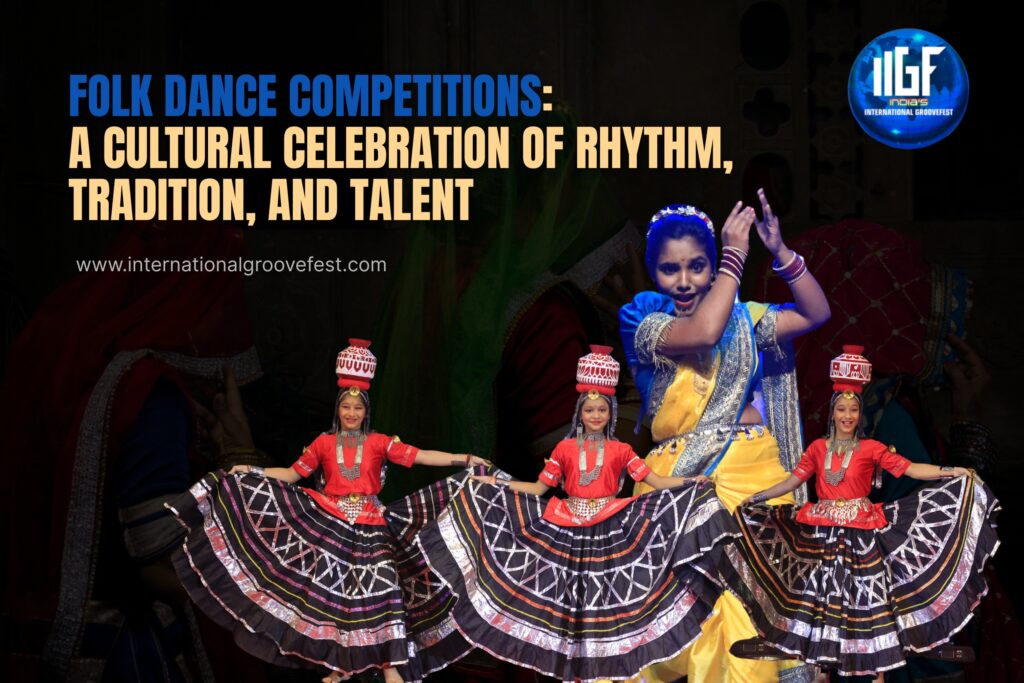
Dance is the heartbeat of every community — a living archive of stories, faith, and identity. Long before stages and spotlights, people danced to celebrate harvests, victories, festivals, and life itself. These movements, passed down through generations, became folk dances — the purest expression of culture. Today, in a world of digital trends and global exchanges, folk dance competitions have emerged as powerful celebrations of heritage and unity. They bring together communities, revive vanishing traditions, and remind us that culture is not something to be preserved in museums — it is something to be lived, performed, and shared.
At India’s International Groovefest (IIGF), this legacy takes center stage. With its National and International Folk Dance Competitions, IIGF redefines cultural pride through rhythm, color, and storytelling — showcasing the beauty of India’s traditions to a wide audience and connecting artists across regions and nations.
The Soul of Folk Dance
Folk dance is the people’s poetry — simple yet profound. Every region of India carries a dance that mirrors its soil, festivals, and beliefs. From the vibrant swirls of Garba in Gujarat to the graceful circles of Ghoomar in Rajasthan, from the fiery Bhangra of Punjab to the lyrical Bihu of Assam, each folk form tells a tale of celebration, devotion, and everyday life.
Unlike classical dance, which follows codified grammar, folk dance celebrates spontaneity and community participation. It invites everyone — young or old, trained or untrained — to move together, creating harmony in diversity. In today’s context, when cultural identities often fade behind technology, the revival of these art forms through events like IIGF’s cultural dance competition becomes an act of preservation and pride. These performances don’t just entertain — they educate, inspire, and connect.
The Rise of Folk Dance Competitions
The idea of a folk dance competition might sound modern, but its roots lie deep in tradition. Villages and towns have long hosted community gatherings where teams competed in dance and song to honor deities or mark harvest festivals.
In the contemporary era, these celebrations have evolved into structured competitions — where folk performers from across the nation gather to showcase their regional heritage. Platforms like IIGF amplify this concept by giving it a larger stage, ensuring that the rhythmic heartbeat of India reaches diverse audiences.
Such competitions serve several purposes:
- Cultural Revival: They preserve traditional dance forms that risk being forgotten.
- Youth Engagement: They inspire younger generations to take pride in their roots.
- National Unity: They bring together diverse communities under one cultural umbrella.
- Artistic Exchange: They foster appreciation for Indian traditions beyond local boundaries.
In essence, the national folk dance competition is not just a contest — it’s a movement of belonging, a statement that India’s diversity is its strength.
IIGF’s Folk Dance Stage: Where Cultures Unite
With six successful international seasons, India’s International Groovefest (IIGF) has built a reputation for celebrating art that transcends boundaries. From Dubai to Sri Lanka, IIGF has brought dancers together in shared celebration. Now, in its latest season, IIGF proudly presents its Folk Dance Competition as a flagship cultural segment. This grand initiative brings together folk troupes, academies, and independent performers from all corners of India — and beyond.
The competition will feature both group performances and solo Indian folk dance categories, ensuring inclusivity for all levels of participation. It’s an opportunity for every artist to showcase the soul of their region while representing the collective spirit of the nation.
Why Folk Dance Matters Today
In a rapidly globalizing world, cultural identity often gets diluted. Folk dance acts as a bridge to our past — a reminder of who we are and where we come from. It keeps communities grounded in their roots while fostering mutual respect and understanding.
Here’s why folk dance competitions are more relevant than ever:
- Preserving Heritage
Each folk dance preserves the language, costume, rhythm, and rituals of its region. Through competitive platforms, these art forms find new life and reach new audiences. - Empowering Rural Artists
Competitions give recognition to performers from smaller towns and villages who rarely get wider exposure. For many, this is their first chance to showcase their art on a larger stage. - Promoting Tourism and Cultural Exchange
Events like the IIGF cultural dance competition draw attention, turning traditional performers into cultural ambassadors. - Strengthening National Identity
When diverse dances from across India share one platform, they form a tapestry of unity — celebrating India’s heritage as one. - Creating Emotional Connection
Unlike contemporary performances, folk dances invite participation and emotion. They remind audiences that dance is not just for the trained — it’s for everyone who feels rhythm in their soul.
Categories in the IIGF Folk Dance Competition
The Folk Dance Competition at IIGF will feature a wide array of performances, showcasing the rich diversity of Indian traditions.
Regional Group Folk Dances
Teams representing Indian states will perform signature styles such as:
- Garba / Dandiya Raas – Gujarat’s colorful celebration of Navratri.
- Ghoomar – The royal swirl of Rajasthani grace.
- Bhangra & Giddha – Punjab’s high-energy expressions of joy.
- Lavani – Maharashtra’s rhythmic storytelling through song and movement.
- Bihu – Assam’s spring festival dance, bursting with vitality.
- Yakshagana / Dollu Kunitha – Karnataka’s dramatic and musical forms.
Solo Indian Folk Dance
A category dedicated to individual performers who carry the energy of an entire community in their movement. Each soloist becomes a storyteller — embodying tradition, costume, and emotion.
Fusion Folk Acts
Modern interpretations that mix regional styles while maintaining authenticity — bridging generations through creative innovation.
These categories ensure that every performer — whether a village troupe or a solo dancer — has a chance to represent their story, region, and spirit.
Participation Guidelines
The IIGF National Folk Dance Competition follows a transparent and artist-friendly process:
Step 1 – Online Registration:
Visit the IIGF official portal and choose the Folk Dance Competition category.
Step 2 – Video Submission:
Upload a 2–4 minute performance video that captures your style, energy, and storytelling essence.
Step 3 – Selection & Announcement:
Submissions will be reviewed by a panel of choreographers, cultural scholars, and folk dance experts. Selected teams will advance to the grand finale.
Step 4 – Grand Performance:
Perform before audiences from around the world, competing not only for awards but also for cultural pride and recognition.
Judging Criteria
Participants in the folk dance competition will be evaluated on:
- Authenticity of Style – Staying true to regional roots.
- Synchronization & Group Dynamics – Harmony in movement and rhythm.
- Costume & Cultural Detailing – Traditional accuracy and visual storytelling.
- Energy & Expression – Enthusiasm, clarity, and emotion.
- Innovation (for Fusion Category) – Creativity while retaining folk identity.
Benefits of Participating
Taking part in a national folk dance competition like IIGF brings far more than awards — it’s a life-changing journey of art and identity.
- Global Exposure: Perform on a stage that reaches a wide audience.
- Cultural Recognition: Gain validation as a representative of your community’s art.
- Career Opportunities: Network with dance institutions, producers, and cultural councils.
- Documentation & Media Visibility: Performances may be featured in digital media and cultural archives.
- Lifetime Memories: Experience travel, teamwork, and the pride of representing your region.
Every step, spin, and smile becomes part of a larger story — a story of India told through movement.
Host & Cross-Cultural Exchange
Rather than focusing on a single location, IIGF emphasizes cross-cultural exchange and accessibility. The event is designed to create opportunities for performers to meet peers, learn from different traditions, and participate in workshops and cultural dialogues. This approach ensures that the festival becomes a hub for artistic growth and mutual learning, where folk artists gain exposure beyond their immediate communities.
Folk Dance: The Heartbeat of Unity
When performers take the stage at IIGF, it won’t just be a competition — it will be a celebration of rhythm and roots. The thunder of drums, the clash of sticks, the swish of ghagras, and the smiles of dancers will create an energy that transcends language and geography.
Through these performances, audiences will witness what makes India extraordinary — its ability to celebrate differences and find unity in diversity.
Every step in this folk dance competition echoes the heartbeat of a nation that dances not for fame, but for faith and joy.
Your Invitation to Celebrate Tradition
If you are part of a school, academy, or community group that lives and breathes folk rhythm — this is your stage.
If you are a solo artist who has preserved your regional tradition through storytelling and dance — this is your moment.
Join the IIGF National and International Folk Dance Competition and let your heritage shine beyond borders. Represent your roots, tell your story, and dance for the pride of your people.
For Registration and Support
📞 +91-9920720488 / +91-9920720244
🌐 Visit the official IIGF website to register for the Folk Dance Competition and become part of this cultural celebration of rhythm, tradition, and talent.
The Rhythm of the People Lives On
Folk dance is not just an art form — it’s the living pulse of humanity. It binds the past with the present, the rural with the urban, and the local with the global.
The Folk Dance Competition at IIGF is more than an event — it’s a cultural revival. It brings generations together, celebrates India’s infinite diversity, and ensures that every dancer, from a village courtyard to an international stage, finds their rightful spotlight.
When the drums of Bihu meet the beats of Bhangra, when Lavani shares the stage with Garba, the world witnesses India in motion — proud, colorful, and unstoppable.
IIGF: Where tradition takes center stage, and the rhythm of the people becomes the heartbeat of the world.


Comments are closed.